


How to Train as a Counsellor in Scotland without Going to University
Updated: Apr 12
Counselling and psychotherapy training in the UK happens in two distinct kinds of places: universities, and specialist training institutes like Physis Scotland. Both lead to professionally recognised qualifications. Both are taken seriously by accrediting bodies. They are simply different routes to the same destination, and they offer quite different experiences along the way.
This article is about the specialist institute route, because it is often the less visible of the two and the one people tend to know least about. If you have been thinking about training as a counsellor and want to understand what this route actually involves, here is what it looks like at Physis Scotland.
A different kind of training environment
Specialist training institutes across the UK offer professionally recognised counselling programmes outside the university system. At Physis Scotland, where we are based in Edinburgh, our counselling training leads to a COSCA-validated Diploma in Counselling using Transactional Analysis, recognised by BACP as a counselling qualification, and a route to practitioner accreditation with either body.
What differs from a university route is not the standard. It is the experience.
The academic standards are no different from what you would find on a university programme. COSCA Counselling Skills is at SCQF Level 8 and our Foundation Year is at postgraduate level. The assessment for Foundation year is rigorous: essays, presentations, reflective journals, observed skills practice, and ongoing participation in group process. What differs is not the depth or the demand. It is the way you get there.
Our training groups are small, a maximum of 18 students per training group. We have a small dedicated team of core trainers who will work with you across the programme, which means they come to know you, your strengths, your edges, and the particular way you are growing into this work. The training is experiential and process-led. You do not just study counselling skills and Transactional Analysis theory in the abstract. You learn it by experiencing it in the room, in real time, with the people around you.
The training group itself becomes a place for genuine personal development. That is by design. Our learning environment is built around what Professor Mike Nolan called the Senses Framework: security, belonging, continuity, purpose, achievement and significance. stimulation, being valued, fun, and motivation. We hold these values at the heart of how we teach, co-creating a space where students feel safe and valued, where they are stimulated and stretched, and where there is room for fun along the way.
What does the training pathway involve?
The pathway into counselling training at a specialist institute tends to be more gradual than a university application process, and for many people that is part of what makes it work. You can take it one step at a time, building confidence at each stage, rather than committing to a multi-year programme upfront.
There are several ways to begin:
A Taster session - two hours online, a chance to meet the team, hear from current students, and get a feel for Physis and the course.
A TA101 – Understanding You, Me and Us, a two-day introductory course that gives you a grounding in the core ideas and an internationally recognised TA101 certificate
Visit us in Edinburgh at our Open Day
Apply for the 1 year part-time COSCA Counselling Skills course.
None of the options require any prior qualifications or experience.
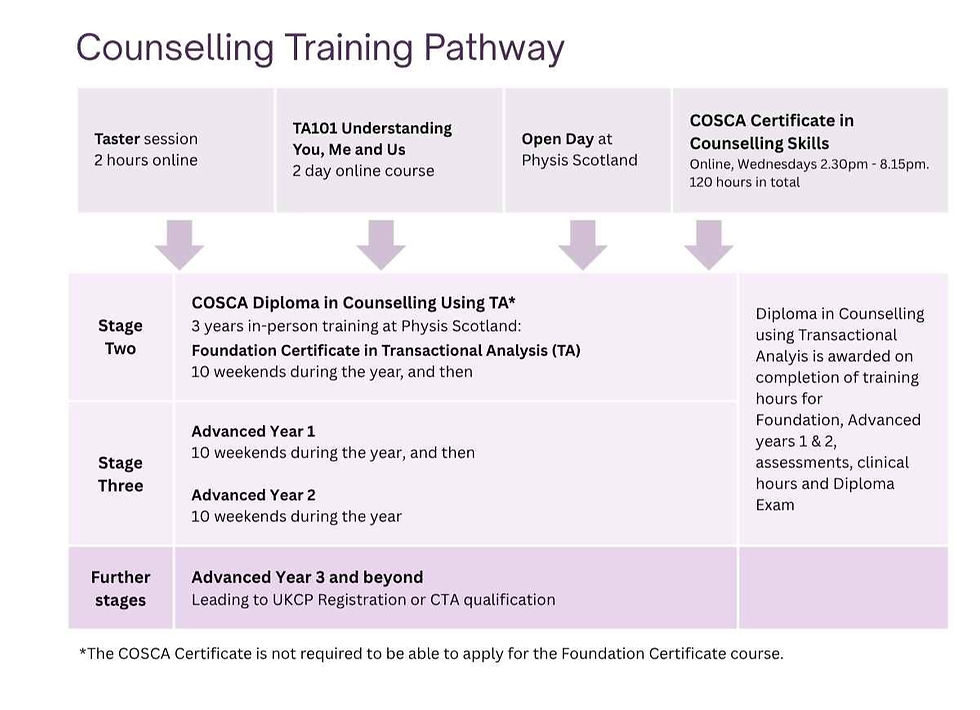
The COSCA Counselling Skills is a COSCA-validated course at SCQF Level 8 that develops core listening and relational skills. It is valuable in its own right, whether you go on to further training or not, and many people find it a helpful way to test the water before moving on to the next stage towards Diploma - the Foundation Year. The COSCA Counselling Skills is not essential, but it is a meaningful stepping stone for people who want to take things one stage at a time.
The Foundation Year is where the counselling training programme begins in earnest. It is a one-year, in-person course in Edinburgh, spread across 20 training days on weekends throughout the academic year. It covers Transactional Analysis psychotherapy theory, counselling skills, and personal development within the group.
Advanced Years 1 and 2 follow on from the Foundation Year. These are the clinical years. You will deepen your theoretical understanding, develop your clinical skills, and undertake supervised placement with real clients. After completing all three years of training, with the endorsement of your supervisor and 100 hours of clinical placement, you are eligible to sit your Diploma exam and qualify as a counsellor.
The whole programme is designed for people who are working, raising families, and managing full lives alongside their training. You are not expected to leave your job or study full-time.
Do I need a degree or specific qualifications?
No. Our entry criteria for the Foundation Year ask for completion of a TA101 course and "a degree and/or equivalent life and work experience." We mean that "and/or" seriously. We value what people bring from voluntary work, parenting, caring, mentoring, managing. If you have spent years in roles where you listen, support, and sit with complexity, that experience matters here.
Our students come from all sorts of backgrounds. Some have degrees, some do not. Some have worked in health, education, or social care. Others come from business, the arts, or the public sector. What they share is curiosity about themselves and other people, and a willingness to be stretched.
We also know that for many of our students, particularly those returning to study after a long time away, academic writing can feel like the most daunting part. Essays, presentations, reflective journals: these are real requirements of the programme, and we take them seriously. But we do not expect people to arrive already fluent in academic writing. We have a Support for Learning team whose role is to help students develop the academic skills they need to meet the level of the course, at whatever pace works for them. If you have not written an essay in twenty years, that is not a barrier. It is something we will help you work through.
The application process reflects this too. There is no UCAS form. Instead, we invite you for an informal interview, which is as much about us getting to know each other as it is about assessing suitability. It is a conversation, not a test.
How much does the training cost?
Our COSCA Counselling Skills course is £1,400 (inc. VAT). The Foundation Year is £3,450 (inc. VAT), and each Advanced Year is the same. Payment plans are available, and you pay year by year as you progress through the programme.
There are additional costs once you enter clinical training, including personal therapy, clinical supervision, and professional body memberships. These are requirements of the profession itself and apply to anyone training to become a counsellor. You can find full details on our fees page.
For many people, the ability to pay year by year, rather than committing upfront, makes a real difference to what feels possible.
Will I be able to work as a counsellor or therapist?
Yes. Graduates of our Diploma programme are qualified to work as self-employed counsellors in private practice. The qualification is COSCA-validated and recognised by BACP, and successful graduates are eligible to apply for practitioner accreditation with either body after completing 450 practice hours.
By the time you qualify, you will already have completed supervised clinical placement with real clients. You leave with experience, not just a Diploma certificate. Private practice, agency work, employee assistance programmes, voluntary sector roles: all of these are open to you.
If you want to take it further
For some of our students, the Diploma is the destination. They qualify as counsellors and go on to work in a counselling role. For others, it is the beginning of a longer journey. Once you have completed your Diploma, you have the option to continue into Advanced Year 3, which is the route towards qualification as a Certified Transactional Analyst and registration as a psychotherapist with UKCP.
That decision does not need to be made at the beginning. It is something that becomes clearer as you train.
What's it really like to train at Physis?
There is one more thing that is harder to put into words but that our students talk about often.
Training at a small, specialist institute feels different. You are not a student number. You are known. The relationships you build with your tutors, your training group, and ultimately with yourself are central to the experience, not incidental to it. Counselling is a relational profession, and it makes sense that the training should be relational too.
Many of our students arrive uncertain. They are not sure this is for them. They are not sure they are ready. They are not sure they belong. And then, gradually, through the work they do in the room and the relationships they build along the way, something shifts. That shift is what we are here for.
About Physis Scotland
Physis Scotland is a specialist Transactional Analysis training institute based at 22 Drumsheugh Gardens in Edinburgh. We offer a full clinical training pathway, from introductory courses through to qualification as a Certified Transactional Analyst and UKCP registered Psychotherapist. We are the only registered TA training establishment in Scotland, and in 2024 we were honoured to receive the Mental Health & Wellbeing Scotland Award for Outstanding Impact in Education.
Ready to take the first step?
You do not need to have it all figured out today. There are several easy ways to find out more:
Book a TA Taster session and meet the team online
Come to an Open Day at our Edinburgh premises
Download our training prospectus
Email Christina, our Programme Manager, at enquiries@physisscotland.co.uk or call 07927 557217
We would love to hear from you


